How we make money: some links on CompareVillas may become affiliate links that pay us a commission if you book. Commission never affects a score or a verdict.
Full disclosure.
Who the Costa Blanca suits Checked July 2026
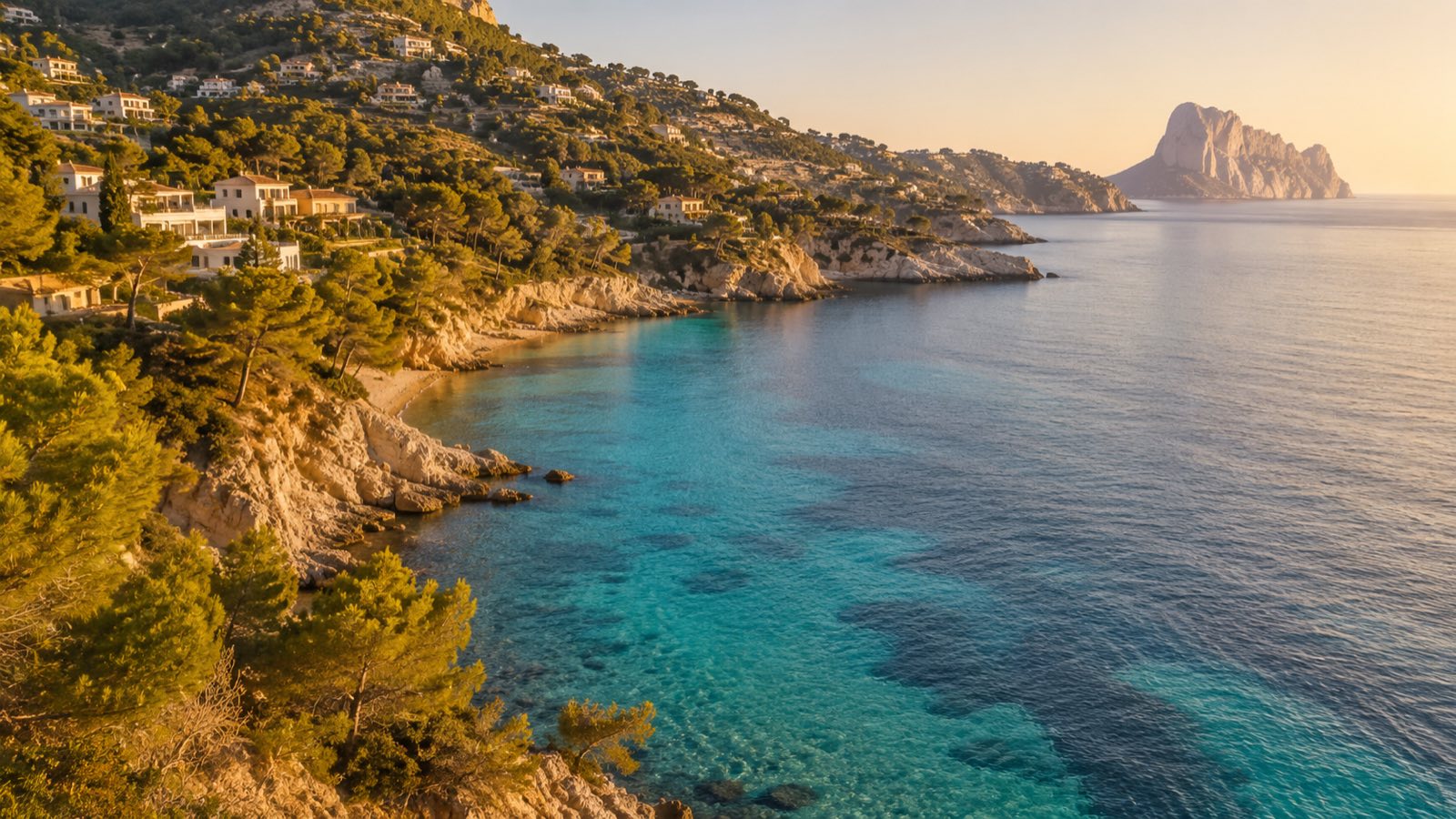
Start with the practical case, because it's one of the strongest in the Mediterranean. Direct flights from London to Alicante take roughly 2½ hours, and there are typically multiple direct flights a day in season from London alone — this is a well-served route year-round. The climate is famously reliable, the AP-7 motorway (toll-free since 2020) runs the length of the coast, and once you turn north past Benidorm the scenery changes completely: the Montgó massif above Jávea and Dénia, the Peñón de Ifach rising out of the sea at Calpe, and between them a coastline of rocky coves, pine woods and white-walled hillside villas. That triangle — Jávea, Moraira, Calpe, with Benissa's coves stitched between them — is where the UK villa companies have concentrated their stock for decades, and for good reason.
Who does it fit best?
- Families who want easy logistics get a short flight, a manageable transfer and villa resorts that have hosted British families for generations — with sandy town beaches at Jávea's Arenal, Calpe and Albir when cove-hopping palls.
- Couples and foodies do well in Moraira and Altea: marina dinners, old-town lanes and a pace that stays gentle even in August.
- Groups who want a proper villa — pool, sea view, space, privacy — are in one of Europe's deepest markets for exactly that. Hillside stock here is plentiful in a way few Greek islands can match.
- Repeat visitors love it precisely because it's established: dependable restaurants, English-friendly services, and villas that come back to the market year after year.
Who does it suit less? If you want wild, undiscovered coastline, this isn't it — the northern Costa Blanca is polished, residential and popular, and its hillsides are built with villas rather than left empty. And if you want to walk out of your villa gate to a beach bar, choose carefully: most villas here sit on residential hillsides a drive from the sand (more on that below, honestly). Neither is a criticism; both are fit questions, and fit is what this guide is for.
One coast, two holidays Checked July 2026
Here's the thing the brochures rarely spell out: "Costa Blanca" covers two products that barely overlap. The southern half — Benidorm down through Alicante to Torrevieja — is high-rise, hotel-and-apartment territory, superbly set up for package holidays and some of the best-value winter sun in Europe. The northern half, from Altea up to Dénia, is where the coast crinkles into coves and the accommodation turns to private villas. If you've booked a villa, you're almost certainly heading north — and the comparison that matters is between the northern towns themselves. Transfer times below are typical driving times from Alicante airport in normal traffic; allow more in August.
Choose Jávea if… North
…you want the most complete base on the coast. Jávea (Xàbia in Valencian — you'll see both) is really three towns in one: a handsome old town a couple of kilometres inland, a working port, and the Arenal — a sandy horseshoe bay ringed by restaurants. Add the pebble coves around the headlands, Granadella most famously, and the hiking on Montgó behind, and it earns its status as the UK market's Costa Blanca capital, with villa stock to match. The honest trade-offs: it's at the far end of the transfer, at typically an hour and a quarter, and the Arenal is properly busy in August. Villas within genuine walking distance of the sand sell out first, every year.
Choose Moraira and the Benissa coast if… North
…your ideal evening is dinner by a small marina, not a strip. Moraira is a former fishing village that has grown up gracefully: low-rise, flower-boxed and quietly affluent, with a couple of small sandy beaches (El Portet is the pretty one) and rocky coves running down the Benissa coastline towards Calpe. The villa stock on the pine hillsides above is the region's signature — whitewashed houses with pools and sea views. Trade-offs: the village is small enough that a fortnight might send you exploring, and almost everything worth renting is a drive from the centre. For couples and calm-seeking families, it's arguably the pick of the coast.
Choose Calpe if… North
…you want the biggest sandy beaches in the north with a villa to come home to. Calpe's two long town beaches flank the Peñón de Ifach, the limestone rock that is the Costa Blanca's most recognisable landmark, and the seafront has a proper resort hum in season. Be honest with yourself about the mix: the centre has high-rise blocks that feel closer to the southern coast's style, while the villa suburbs towards Moraira — La Fustera, Maryvilla — are classic hillside villa country. If your group wants beach mornings, promenade evenings and a pool between them, Calpe delivers at a shorter transfer than Jávea; if you're allergic to any high-rise on the skyline, look one headland north.
Choose Altea and Albir if… North
…walkability and charm outrank sand. Altea's whitewashed old town, stacked up a hill beneath a blue-domed church, is the prettiest townscape on the coast, and neighbouring Albir offers something genuinely rare here: a flat, walkable resort with a neat promenade where a villa without a car is actually practical. The trade-offs are honest ones: the beaches are pebble and shingle rather than sand, and the villa stock is thinner than in the Jávea–Moraira–Calpe triangle, with apartments taking a bigger share. For grandparents, buggies and anyone who'd rather stroll than drive, this corner — with the shortest transfer of the villa coast at typically under an hour — is quietly excellent.
Choose Dénia if… North
…you want a real Spanish town first and a resort second. Dénia is a working port town with a castle above it, a serious food culture, long sandy beaches stretching north and rocky coves running south below Montgó. It's also the coast's escape hatch: Baleària ferries sail from Dénia to Ibiza in around two to three hours daily, and on to Mallorca — a genuine island day trip from a mainland villa. Trade-offs: the villa stock is more scattered than the triangle's, split between the beach strip north of town and country properties inland, and the transfer matches Jávea's. Tip: for Dénia and Jávea, flying to Valencia instead of Alicante is a legitimate option, at roughly an hour and a half's drive south.
Choose the resort south if… South
…what you actually want is a package holiday — and there's no shame whatsoever in that. Benidorm's Levante and Poniente beaches are two of the best urban sands in Europe, the entertainment is unmatched, and the southern coast down through Torrevieja does winter sun better than almost anywhere on the mainland. It's simply a different product: hotels and apartments, not hillside villas, and the villa stock that does exist is thin and untypical. If you've read this far wanting a villa, head north of Altea; if the south's energy is calling you, book the package with a clear conscience — and know Benidorm's theme parks are still within day-trip range of an Altea or Calpe villa.
The urbanisation question — the north's honest trade-off
The prettiest villa stock on this coast sits on urbanisations — residential hillside estates above the towns, built over decades precisely because the views are spectacular. And they are: sea panoramas, pine-scented privacy, pools that catch the sun all day. Here's what the listings gloss over: hillside means hillside. Drives are often steep and switchbacked, "ten minutes to the beach" usually means by car, and walking home from dinner can be a 25-minute climb you'll do exactly once. None of this is a flaw — it's a fit question. A hillside villa suits groups who'll hire a car without grumbling and treat the terrace as the holiday's centre of gravity. It frustrates people who pictured strolling to breakfast. If walkability matters to you, say so before you book and check the contour lines, not just the distance — which is exactly what our scored shortlists will measure from open map data.