How we make money: some links on CompareVillas may become affiliate links that pay us a commission if you book. Commission never affects a score or a verdict.
Full disclosure.
Who Fuerteventura suits Checked July 2026
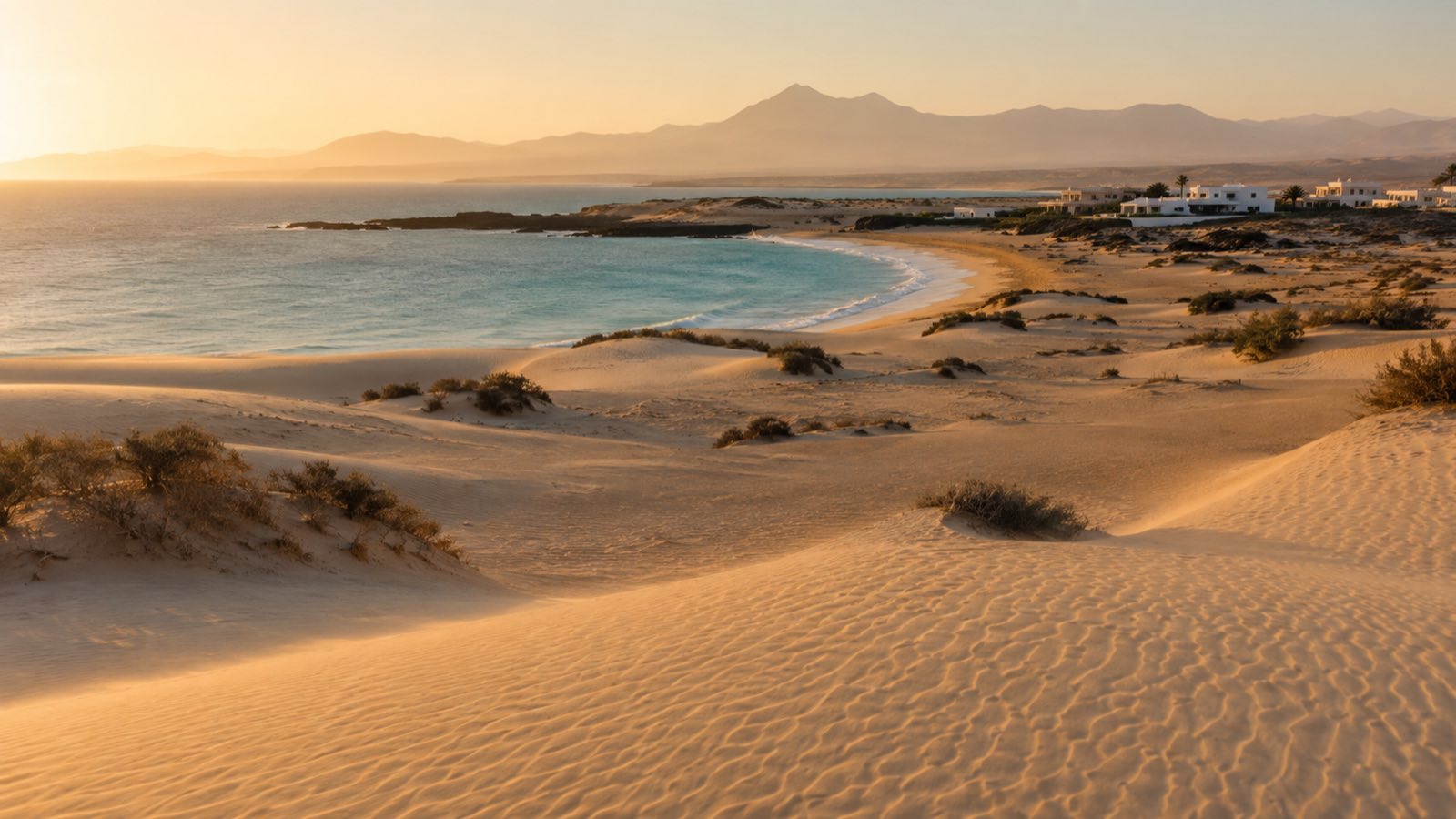
Start with the beaches, because — for many — nowhere else in the Canaries competes. In the north, the Corralejo dunes — a protected natural park of around 2,600 hectares — spill pale sand into shallow turquoise water for kilometre after kilometre. In the south, a sandbar sitting typically 100–300 metres offshore encloses the Sotavento lagoon, a sheet of knee-deep water that fills and empties with the tide along one of Europe's great expanses of sand. If white-sand-and-clear-water is the picture in your head, this is the Canary island that actually delivers it — the others mostly offer black volcanic coves or engineered beaches.
The practical case is just as strong. Direct flights from London typically take around 4–4½ hours and — unlike most Mediterranean villa islands — run year-round, with January average highs around 21°C making genuine winter sun. UNESCO declared the whole island and a strip of its surrounding ocean a Biosphere Reserve in 2009, which is a fair summary of the landscape: arid, open, volcanic and largely empty, closer to a desert island with beach resorts attached than to a green Mediterranean idyll.
Who does it fit best?
- Beach families get sheltered Caleta de Fuste minutes from the airport, walkable Corralejo beside the dunes, and the reef-calmed lagoons at El Cotillo for some of the best paddling on the island.
- Surfers, windsurfers and kiters have a world-stage island: the professional windsurfing world tour has stopped at Sotavento since 1986, and the north-west villages live and breathe surf.
- Winter-sun escapers get year-round flights and low-twenties January days — with a heated pool as the filter that matters.
- Space-seekers get an island of open horizons: villa villages like Lajares and Villaverde where the entertainment is a bakery, a volcano walk and a very dark sky.
Who does it suit less? If your dream villa sits among pines, vineyards or lemon groves, this arid island will feel stark — that's geology, not a flaw. If you want the boutique end of the UK villa market, be aware most luxury specialists don't operate here at all (details below). And if you're hoping to "do the whole island" from one base, respect the distances: Fuerteventura is around 100 km end to end, and the two great beach zones sit at opposite ends of it. All fit questions — and fit is what this guide is for.
The five Fuerteventuras, compared Checked July 2026
Fuerteventura's single airport (FUE) sits on the east coast just south of the capital, Puerto del Rosario — conveniently central, which means nowhere is punishingly far, but the island is long: driving Corralejo in the north to Morro Jable in the far south typically takes around 1½ hours. So the first decision is which end of the island you're holidaying on. Transfer times below are typical driving times in normal traffic; allow more in peak weeks.
Choose Corralejo if… North
…you want the fullest version of the island in one base — most first-timers should start here. Corralejo is a real town that grew from a fishing harbour, not a strip built in a decade: the old quarter's lanes hold one of the island's best restaurant scenes, the town beaches are sandy and sociable, and the great dunes begin just south-east. Ferries cross to Lanzarote's Playa Blanca in roughly 25–35 minutes and to the tiny protected islet of Lobos in about 15–20, so days out multiply. It's also where the UK operators concentrate their deepest Fuerteventura stock, much of it with heated pools. Honest trade-offs: the town is the island's busiest, and the newer villa estates north of the centre put the harbour a longish walk away — check the actual distances.
Choose the north-west villages if… North-west
…you want the characterful Fuerteventura the brochures skip. Lajares is an inland surf village with a disproportionate supply of good cafés and bakeries and a Saturday craft market; Villaverde is quieter still, low white houses under a volcano; and El Cotillo, on the coast, pairs a small harbour town with some of the island's loveliest swimming — the reef-sheltered lagoon beaches and white-sand La Concha, calm even when the ocean beyond is churning. The villa stock is rural and individual rather than resort-built. The deal, stated plainly: you'll drive for almost everything, the surf beaches proper are for competent surfers rather than swimmers, and none of the specialists we track lists villas in these villages — the stock lives on the platforms, so vetting falls to you. That's exactly the gap our villa finder is built to close.
Choose Caleta de Fuste if… East
…ease is the brief. This is the shortest airport-to-sunlounger run on the island — typically 10–15 minutes — and the resort was purpose-built for exactly the holiday most families book: a sheltered, curved bay that stays calm when the open coasts are blowing, a walkable centre, and two 18-hole golf courses beside the resort, one of which hosted the Spanish Open in 2004. It is not the place for Canarian authenticity, and nobody honest will tell you otherwise — it's a made resort doing a made resort's job well. Trade-offs: the beach, though safe and convenient, is modest next to the island's famous sands, and the villa stock is modern-estate rather than characterful. For first Canaries trips with young children, it's hard to argue with.
Choose Costa Calma and Sotavento if… South
…the beach itself is the holiday. South of Costa Calma the coast becomes the Playas de Sotavento — a run of sand so vast that at low tide a lagoon forms behind an offshore sandbar, knee-deep and warm, before the tide folds it away again. It's one of the great beach spectacles in Spain, and the reason the windsurfing world tour has pitched up here almost every year since 1986. Costa Calma itself is a purpose-built, low-key resort, softened by a rare planted belt of palms and pines through its middle. Honest trade-offs: this is the windy end of a windy island — the resort sits on the island's narrow isthmus, where the trade winds cross undisturbed (the name means "calm coast" and refers to the leeward sea, not the air). Villas are a smaller share of the stock here than in the north, and the transfer is typically an hour-plus.
Choose Jandía and the far south if… Far south
…you already know you want maximum beach and minimum else — and even then, book it with open eyes. The sands of the Jandía peninsula are the island's biggest, running past Morro Jable's lighthouse in a scale that has to be seen. But this is honestly hotel-and-apartment country: the front is a chain-hotel promenade, true villas are scarce, and the transfer is the island's longest at typically 1 h 10–1 h 25. Morro Jable's old fishing-town corner supplies the character, and beach connoisseurs on a second or third visit will understand the appeal. For a first villa holiday, the north does the same island better — which is why our coverage, like the operators', concentrates there.
The wind question — Fuerteventura's honest trade-off
Fuerteventura's beaches come with an engine attached. The trade winds are why the island hosts a windsurfing world cup and why high summer feels fresher than the latitude suggests — and they blow strongest in exactly the school-holiday months, roughly June to September. Brochures rarely mention it; beach days on the open strands can mean flying sand, and a sundowner can need a windproof jacket. None of it is a dealbreaker — it's a fit question. Wind-sports families should aim at Sotavento and the north shore and book early. Stillness-seekers should favour Caleta de Fuste's sheltered bay or El Cotillo's lagoons, look for villas with walled or windbreak-planted terraces, and consider May, October or winter, when the trades ease. What you shouldn't do is book a clifftop villa in July expecting Mediterranean calm — that's the mismatch this guide exists to prevent.