How we make money: some links on CompareVillas may become affiliate links that pay us a commission if you book. Commission never affects a score or a verdict.
Full disclosure.
Who Menorca suits Checked July 2026
Start with the fact that shapes everything else: UNESCO declared the entire island a Biosphere Reserve on 8 October 1993, recognising how well Menorca had balanced tourism with conservation. Three decades on, the result is visible from any beach — development that stayed contained, a coastline where many of the prettiest coves have no buildings on them at all, and a pace of life that the neighbouring islands lost decades ago. Direct flights from London take around 2¼ hours, and because Menorca is small and the airport sits just outside Mahón, almost nothing on the island is more than about an hour's drive from arrivals.
One honesty note before the sales pitch: most UK routes to Menorca are summer-seasonal, running roughly from late April to October. Fly outside those months and you'll usually connect through Barcelona or Madrid. It's a summer island in the practical sense as well as the poetic one.
Who does it fit best?
- Families with young children get the island the Balearics designed for them: shallow, sheltered south-coast sands, short transfers, and resorts where the evening entertainment is an ice cream on the promenade.
- Couples who want calm do beautifully around Fornells, Ciutadella's old town or a countryside farmhouse — Menorca at dusk is one of the Mediterranean's quietest pleasures.
- Walkers and swimmers have the Camí de Cavalls, the historic bridle path of around 185km that rings the whole coastline, linking cove after undeveloped cove.
- Anyone allergic to high-rise holiday strips is in the right place: the Biosphere ethos kept them out.
Who does it suit less? Anyone whose holiday needs buzz. Menorca has no clubbing scene worth the name, few late bars and a nightlife that mostly means dinner running long. Teenagers who want action, groups who want beach clubs and DJs, anyone who measures an evening by its options — Mallorca and Ibiza are a short hop away and genuinely better fits. That's not a flaw in Menorca; it's the deal the island struck, and the people it suits tend to guard it jealously.
The five Menorcas, compared Checked July 2026
Menorca has one airport, Mahón (MAH), near the island's eastern end — so transfer times run west, and Ciutadella at the far end is the longest common ride at under an hour. From there the areas differ on beach character, shelter from the north wind, and how much town you get on your doorstep. Transfer times below are typical driving times in normal traffic; allow more in August.
Choose Ciutadella and the west if… West
…you want the most complete single base. Ciutadella, the island's former capital, is Menorca's handsomest town — a Gothic cathedral, cobbled lanes, a slender old harbour lined with restaurants — and the west-coast resorts of Cala'n Bosch and Cala Blanca put sand and boat trips within easy reach. The trade-off is the transfer: at typically 45 minutes to an hour, it's the longest on the island, though "longest on Menorca" would count as short almost anywhere else the UK flies to.
Choose the south-coast calas if… South
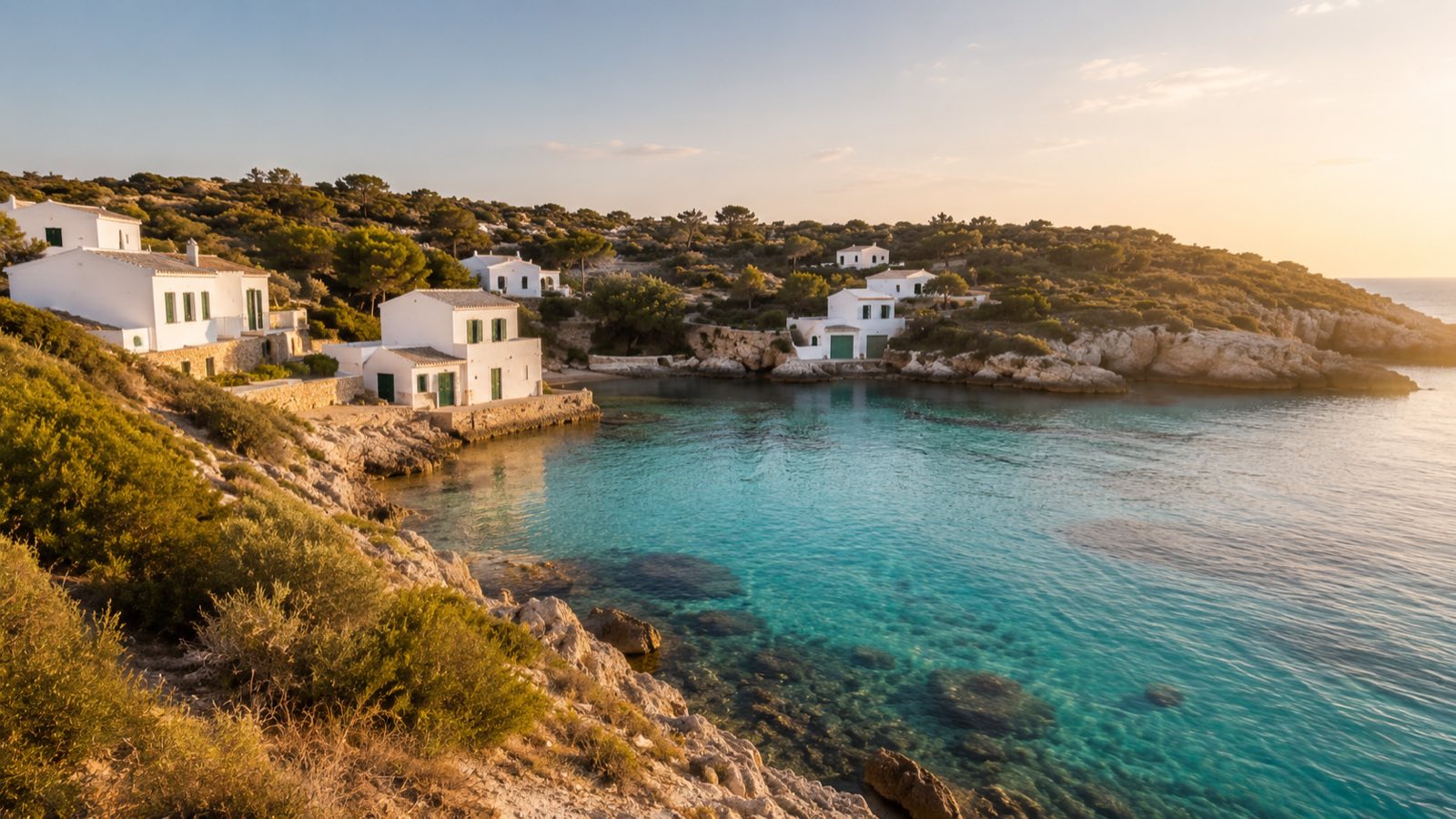
…the beach is the holiday. This is the Menorca of the photographs: sheltered white-sand coves framed by pines and pale cliffs, with Cala Galdana the family hub, Santo Tomas its quieter neighbour and Son Bou stretching out as the island's longest beach. It's also the calmest water in normal summer conditions, because the south coast sits in the lee of the north wind. Trade-offs: the resorts are purpose-built rather than characterful, hillside villas can mean a real climb home, and the most photographed undeveloped coves nearby are reached on foot down pine paths — beautiful, but bring water and go early in August.
Choose Mahón and the east if… East
…you'd rather have towns, harbours and restaurants than one big beach. Mahón sits on one of the Mediterranean's largest natural harbours, the villages around it — Es Castell, Sant Lluís, whitewashed Binibeca — are the island's prettiest places to wander at dusk, and the airport is ten to twenty minutes away, which makes this the easiest arrival in the Balearics. The honest catch: the east does coves rather than big sands, so committed beach families may find themselves driving south more days than not.
Choose Fornells and the north if… North
…your family sails, paddles or windsurfs — or you simply want the quietest coast of a quiet island. Fornells is a whitewashed fishing village on a huge, almost enclosed bay: flat water for water sports, a harbourside strip known for its lobster stew, and very little else, which is the point. The north coast beyond is Menorca's wild side — red-gold sand, few buildings, and exposure to the Tramuntana wind when it blows. Villa stock is thinner here than in the south, so book early or be flexible.
Choose the rural interior if… Centre
…the villa is the holiday and the island is the day trip. The farmhouses around Alaior, Es Mercadal and Ferreries are Menorca's answer to the Mallorcan finca — whitewashed, walled and private, with pools and proper gardens — and because the island is small, the entire coastline is a 15 to 30 minute drive. That's the interior's quiet superpower: you're not committed to one coast, so you can chase whichever beach the day's wind favours. The deal in return: you will drive to every swim, most dinners and the bakery.
The gentleness question — Menorca's honest trade-off
Every Menorca brochure says "unspoilt", and for once the word is earned — the Biosphere Reserve status is real, the coves genuinely are protected, and the island at night is dinner, a promenade stroll and stars. Here's what that means in practice: no nightlife to speak of, few late bars, resorts that are quiet by ten, and a fair chance that teenagers used to livelier islands will call it boring by Wednesday. None of this is a flaw — it's the whole proposition. Menorca suits people who are buying peace on purpose: young families, couples, readers, swimmers, walkers. If your group needs an evening scene to choose from, Mallorca next door does both worlds brilliantly and honestly deserves your booking instead. Fit first — that's what this site is for.