How we make money: some links on CompareVillas may become affiliate links that pay us a commission if you book. Commission never affects a score or a verdict.
Full disclosure.
Who Provence & the Côte d'Azur suit Checked July 2026
Start with the enviable practical case. Direct flights from London reach Nice in roughly two to two and a quarter hours, and the route is flown year-round — Nice Côte d'Azur is France's busiest airport outside Paris, handling a record 15.2 million passengers in 2025 per the airport's own figures. Marseille is about two hours from London and was likewise served daily at our July 2026 check. Inland Provence has a third door: Avignon TGV, around 2 h 40 from Paris at its fastest, putting the Alpilles about 25 minutes from a train platform. One honest rail note — Eurostar's direct summer trains to Avignon and Marseille are not running in 2026, per Eurostar's own site, so going by train means changing in Paris, Lille or Brussels.
Then the case for the place itself, which needs little selling. This is a corner of France thick with UNESCO World Heritage listings — Arles and Orange among them — and two of them bookend this guide: Avignon's Papal Palace ensemble, inscribed in 1995, anchors the inland west, while Nice itself was listed in 2021 as "Winter Resort Town of the Riviera" — the world's heritage body certifying what British visitors have known for two centuries. In between: the Luberon's hill villages (five of them officially among Les Plus Beaux Villages de France), a landscape protected as a regional nature park since 1977, and a coastline that invented the modern idea of glamour.
Who does it fit best?
- Villa-first couples and groups get the region at its purest inland: stone mas with pools among vines and orchards in the Luberon and Alpilles, market mornings, long lunches — the villa is genuinely the holiday here.
- Families who want sand should look at Antibes and Juan-les-Pins, whose town beaches are properly sandy, with the deepest UK villa stock in the hills just behind.
- Glamour-seekers have the St-Tropez peninsula — Pampelonne's roughly four to five kilometres of sand at Ramatuelle and arguably the most famous little port in the Mediterranean.
- City-and-culture types do well around Nice: a real, UNESCO-listed city with a promenade, markets and serious food — best treated as a walkable base, not villa country.
Who does it suit less? Anyone planning to "do" both halves from one villa — the distances are honestly bigger than the map suggests, and August traffic magnifies them (more below). And travellers who picture golden sand everywhere: Nice's beaches are pebble, and sand is concentrated in specific, checkable places. Neither is a flaw; both are fit questions, and fit is what this guide is for.
The five souths of France, compared Checked July 2026
Two airports and a TGV station serve five very different bases. Every comparison starts with a verifiable fact: how far you'll travel after landing — and, in this region, which arrival point to choose in the first place. Transfer times below are typical driving times in normal traffic against transfer-company published figures; allow considerably more on summer weekends, and around the Gulf of Saint-Tropez in particular.
Choose the Luberon if… Luberon
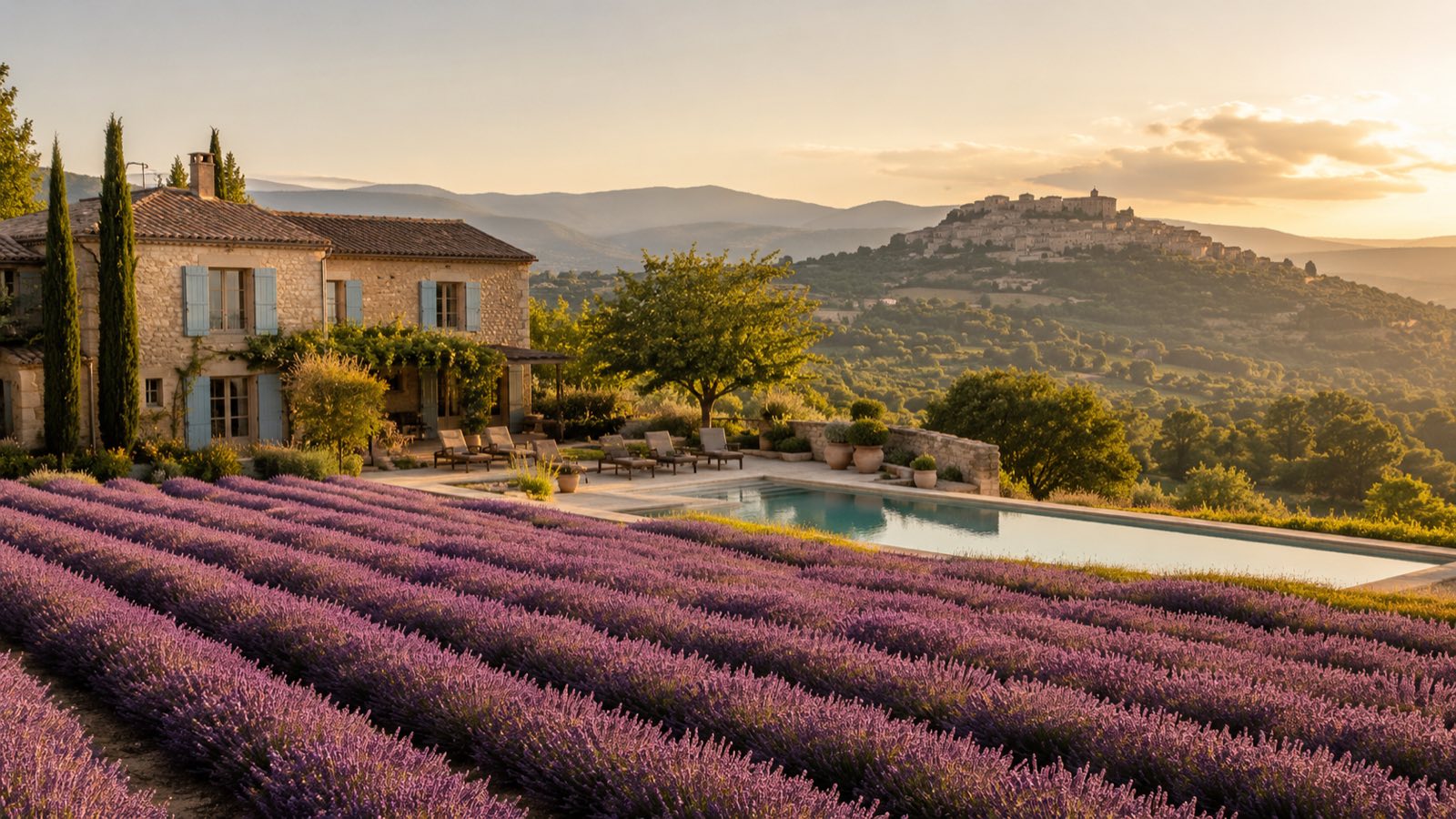
…the villa is the holiday. This is the Provence of the books: a regional nature park since 1977 and a UNESCO-listed biosphere since 1997, strung with hill villages of which five — Gordes, Roussillon, Ménerbes, Lourmarin and Ansouis — carry the official Plus Beaux Villages de France label. The stone mas here, with its pool, plane-tree shade and market-day rhythm, is one of Europe's great villa archetypes. The honest trade-offs: there is no beach within casual reach, evenings mean driving unless you're on a village edge, and the lavender the brochures promise is a late-June-to-July event that can be cut by mid-July in hot years — travel in August and much of it is already harvested.
Choose the Alpilles and Saint-Rémy if… Alpilles
…you want inland Provence with the logistics sanded smooth. Saint-Rémy is a proper market town with a genuinely walkable restaurant ring, Les Baux and Eygalières are minutes away, Avignon's Papal Palace — UNESCO-listed since 1995 — is an easy evening trip, and the Avignon TGV station is only about 25 minutes from your villa gate, which makes this the rare French villa base you can reach by rail without a long onward drive. Trade-offs, honestly stated: the mistral is real here — a strong, cold northerly that funnels down the Rhône corridor and can blow for days, most often outside high summer — and, as everywhere inland, the beach is a committed day trip.
Choose Antibes, Cannes and the hills behind if… Riviera West
…you want the coast with sand and a villa that feels like one. Antibes and Juan-les-Pins keep several kilometres of maintained, genuinely sandy public beaches — a Riviera rarity worth planning around — and the transfer from Nice is a civilised 20–45 minutes. Just as important: when UK operators say "French Riviera villa", this hinterland is usually what they mean. The stock clusters in the villages behind the bays — Biot, Fayence, St-Cézaire-sur-Siagne, the countryside behind Cannes — typically with pools, views and a 20–40 minute drive down to the sand. That's not a catch, it's the deal: coast access plus villa privacy, with a car doing the connecting.
Choose Nice and the coast east if… Nice
…walkability beats a private pool. Nice is the base to pick when you want a real city doing real things: the Cours Saleya market, the promenade, old-town restaurants, trains along the coast — all UNESCO-endorsed since 2021, when the city was inscribed as "Winter Resort Town of the Riviera". Book it honestly, though: the beaches are pebble, not sand, and this is apartment country — genuine villas near the city are scarce and sit up in the hills. For couples and older-kid families who'll walk everywhere and treat the sea as a swim rather than a sandcastle site, it's a brilliant fit; bucket-and-spade families do better west at Antibes.
Choose the St-Tropez peninsula if… St-Tropez
…the name is the point — and you plan around the roads. The peninsula has the coast's great sand prize in Pampelonne, the port's café theatre, and hill villages like Ramatuelle and Gassin above the vines. The honest mechanics: the gulf is reached on two-lane roads, and in July and August the drive from Nice — about an hour and a half in normal traffic — can stretch to three or four hours, with jams from Sainte-Maxime inwards; the town's own tourist office is candid about summer congestion. Fit-finding, not fear: base on the peninsula and walk or use boat shuttles, or take the gentler Grimaud–Sainte-Maxime side of the gulf, and the glamour works. Commuting into St-Tropez daily from elsewhere doesn't.
The one-holiday myth — this region's honest trade-off
Provence and the Côte d'Azur share a tourist board and a poster, and that poster quietly merges two different holidays. The distances are bigger than almost everyone expects: Gordes to Saint-Tropez is typically around two and a half hours' drive each way in normal traffic — before the gulf's famous summer queues, which can add hours in August. A Luberon villa with "the coast nearby" and a Riviera villa with "lavender country at hand" are both, honestly, describing a five-hour round trip. None of this is a flaw — it's a decision. Choose inland or coast first, enjoy the other as one well-planned day out, and the region delivers either holiday superbly. Try to run both from one base and you'll spend your week in the car. Listings rarely say this out loud, which is why our scoring measures real driving and walking distances from open map data and states them plainly.